17th Century Royal Astrolabe, a Marvel of Mughal Science, Set for Sotheby’s Auction
A rare, massive brass astrolabe from Jaipur’s royal collection goes under the hammer in London

LAT Editorial Team

Anuncio
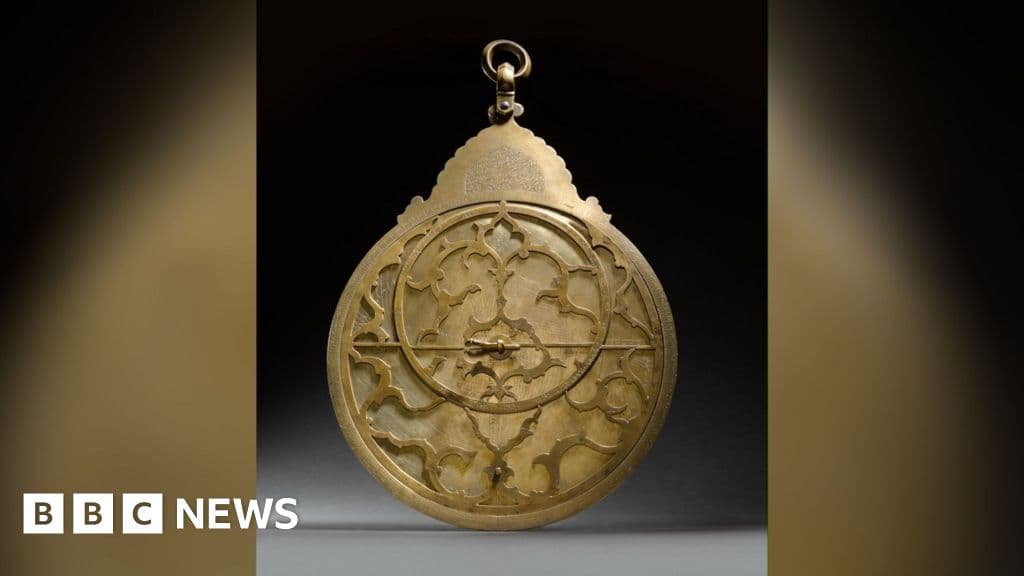
A stunning 17th-century brass astrolabe, once owned by the royal family of Jaipur, is poised to captivate collectors and museums alike as it heads to auction at Sotheby’s London on April 29. This extraordinary astronomical instrument, described as possibly the largest of its kind, has remained hidden from public view until now.
Beyond its royal provenance, the astrolabe represents a pinnacle of Mughal-era craftsmanship and scientific achievement. Its intricate design and precision reflect the era’s fascination with astronomy and astrology, making it a priceless artifact that bridges art, science, and history.
Anuncio
A Royal Treasure Rediscovered
This magnificent astrolabe was once part of Maharaja Sawai Man Singh II’s collection in Jaipur and later inherited by his wife, Maharani Gayatri Devi, a celebrated icon of her time. After her passing, it entered a private collection, remaining unseen by the public until Sotheby’s announced its upcoming sale.
Anuncio
The Astrolabe: The 17th Century’s Supercomputer
Astrolabes are intricate brass devices used historically to tell time, chart stars, determine the direction of Mecca, and even predict future events. Dr. Federica Gigante from Oxford compares them to modern smartphones due to their multifunctionality, capable of calculating sunrise and sunset times, measuring building heights, and more.
- Timekeeping and celestial navigation
- Mapping stars and constellations
- Determining the direction of Mecca for prayers
- Calculating distances and heights
- Astrological predictions and horoscope casting
Anuncio
Crafted by Lahore’s Finest Artisans
Created in early 17th-century Lahore, now in Pakistan, this astrolabe was crafted by brothers Qa'im Muhammad and Muhammad Muqim, renowned members of the Lahore School of astrolabe makers. Commissioned by Mughal nobleman Aqa Afzal, the piece’s grand scale and exquisite detail reflect his high status and the era’s scientific sophistication.
Weighing 8.2kg and measuring nearly 30cm in diameter, it is nearly four times larger than typical astrolabes from the period. Its design uniquely blends Persian star names with Sanskrit inscriptions, showcasing a remarkable cultural fusion.
Anuncio
Unmatched Precision and Artistic Beauty
The astrolabe features 94 cities with precise longitude and latitude markings, 38 star pointers connected by intricate floral patterns, and five finely calibrated plates with degree divisions accurate to a third of a degree. Benedict Carter of Sotheby’s highlights how this piece exemplifies the Lahore School’s peak craftsmanship, combining technical accuracy with stunning artistry.
"It is not only big, beautiful and heavy, it is so incredibly accurate that it will give you the exact degree of altitude of a celestial body.",—Dr. Federica Gigante
Anuncio
A Historic Auction with Global Appeal
With an estimated value between £1.5 million and £2.5 million, this astrolabe is expected to draw intense interest from museums and collectors worldwide. Its pristine condition and royal heritage make it a standout piece in the history of scientific instruments. The auction could set a new record, surpassing the previous high of just under £1 million for an Ottoman astrolabe sold in 2014.
The astrolabe will be on public display at Sotheby’s London galleries from April 24 to 29, offering a rare opportunity to witness this extraordinary fusion of science, art, and history.