Robots Revolutionize Waste Sorting as Industry Faces Staffing Crisis
Humanoid robots and AI step in to tackle hazardous, high-turnover recycling jobs

LAT Editorial Team

Ad
A family-run waste management firm in east London is turning to humanoid robots to address severe staffing challenges in its recycling plant. The facility processes hundreds of thousands of tonnes of mixed waste annually, but the dusty, noisy, and hazardous environment leads to a 40% staff turnover and a work-related injury rate far above the national average.
To combat these issues, the company is training a robot named Alpha to sort waste alongside human workers. This move reflects a broader industry shift toward automation, driven by the need to improve safety, efficiency, and sustainability in waste processing.
Ad
The Harsh Realities of Waste Sorting Work
At Sharp Group’s recycling plant in Rainham, east London, workers face relentless conveyor belts carrying everything from shoes to concrete blocks. The environment is dusty and noisy, making it a tough place to work. With injury rates 45% higher than other industries and a fatality rate multiple times the national average, retaining staff is a constant struggle.
"The belt is moving all the time, you're constantly picking. I go through a lot of pickers because they just aren't up to the job."—Ken Dordoy, Line Supervisor
Ad
Alpha: The Humanoid Robot Learning to Sort Waste
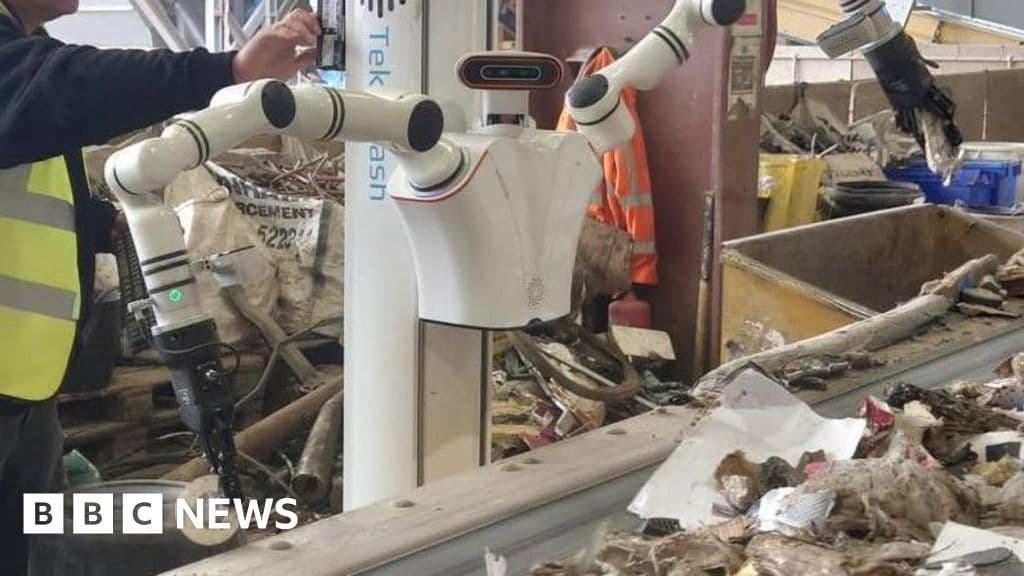
Sharp Group is piloting Alpha, a humanoid robot developed by RealMan Robotics and adapted by TeknTrash Robotics, to assist with sorting. Unlike traditional robotic systems, Alpha mimics human arm movements, allowing it to integrate seamlessly into existing plants without costly redesigns.
Currently in training, Alpha learns to identify and pick items from the conveyor belt using data from multiple cameras and VR-guided human demonstrations. This extensive data collection is crucial to teaching the robot to handle the unpredictable nature of waste.
"The market thinks these robots are prêt-à-porter, that all you need to do is to plug them to the mains and they will work flawlessly. But they need extensive data in order to be effectively useful."—Al Costa, CEO of TeknTrash Robotics
Ad
AI and Automation Transforming Recycling Efficiency
Other companies are also innovating with AI-driven sorting technologies. Colorado-based AMP uses air jets and AI to sort materials at speeds up to ten times faster than humans, while California’s GlacierAI employs robotic arms and machine learning to improve sorting accuracy over time.
- AMP’s system uses AI and air jets to efficiently separate materials.
- GlacierAI’s technology adapts to diverse waste, even handling unexpected hazards like firearms.
- Both companies emphasize scalability for urban and semi-rural facilities with varying budgets.
"Robotics coupled with AI-driven vision systems offers the greatest potential for improving material recovery, worker experience, and economic competitiveness in the recycling sector."—Prof Marian Chertow, Yale University
Ad
The Future: Upskilling Workers and Safer Workplaces
While robots like Alpha promise 24/7 operation without breaks or injuries, human workers remain essential. Sharp Group plans to upskill its staff to maintain and oversee robotic systems, moving them away from hazardous tasks and improving their working conditions.
This transition marks a critical evolution in waste management, balancing technological innovation with workforce development to create safer, more efficient recycling operations.