Honor's D1 Robot Smashes Half-Marathon World Record by Nearly 7 Minutes
A humanoid robot built by Honor outpaces human runners with groundbreaking speed and endurance

LAT Editorial Team

Ad
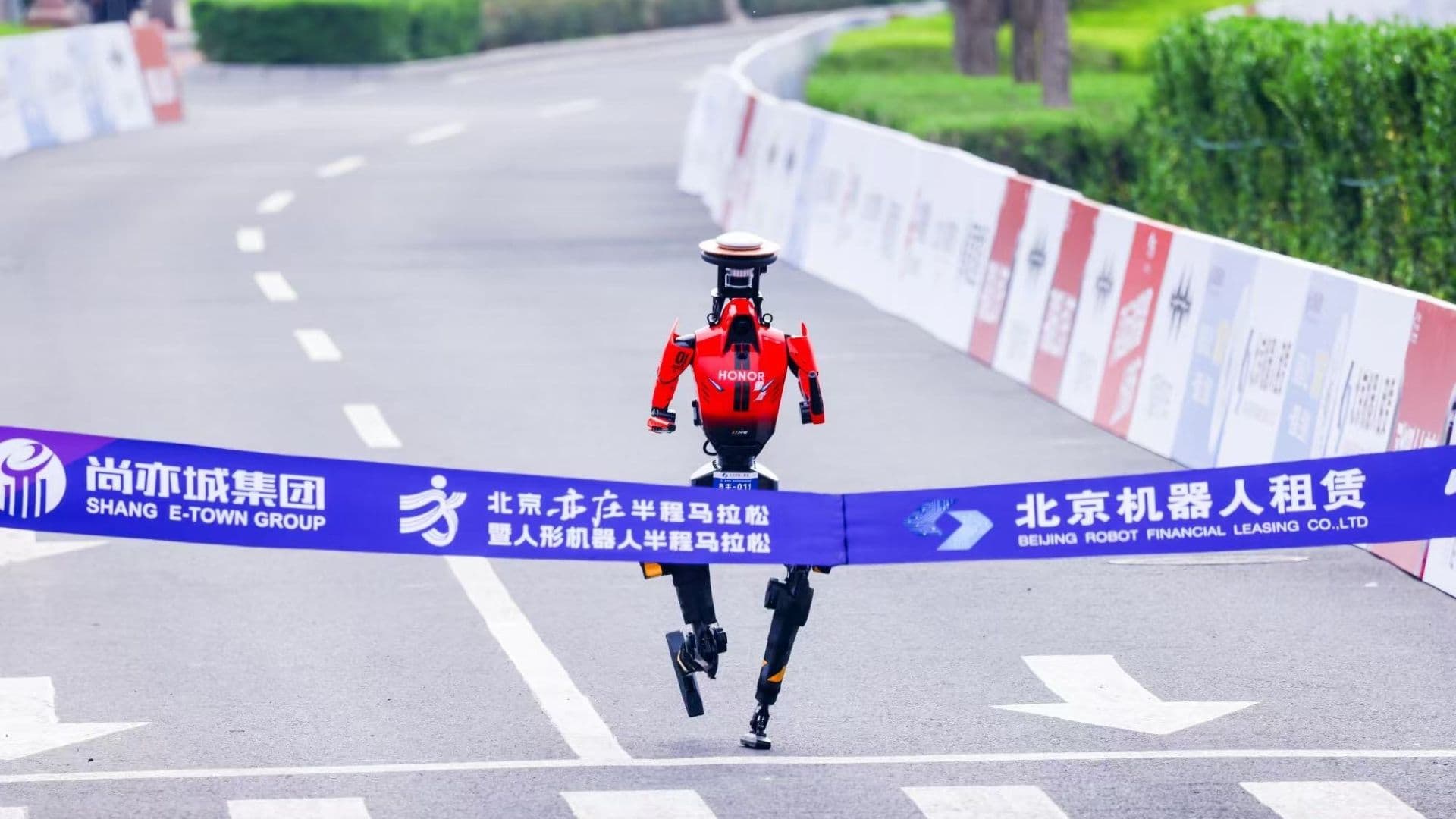
In a stunning display of robotic athleticism, Honor's autonomous humanoid robot, the D1, has shattered the human half-marathon world record by completing the 13.1-mile race in just 50 minutes and 26 seconds. This achievement eclipses the previous record of 57 minutes and 20 seconds set by Ugandan runner Jacob Kiplimo in March 2026.
This milestone highlights rapid advancements in robotics, showcasing how machines are now capable of sustained high-speed running with sophisticated cooling and navigation systems. The D1's performance signals a new era where humanoid robots can compete in endurance sports, pushing the boundaries of artificial intelligence and mechanical engineering.
Ad
Record-Breaking Performance at the 2026 Beijing E-Town Humanoid Robot Half-Marathon
The D1 robot stunned spectators at the Beijing E-Town event by finishing the half-marathon in 50 minutes, 26 seconds, beating the human record by nearly seven minutes. Notably, another robot from Honor completed the race even faster at 48 minutes, 19 seconds, but was disqualified from the official win due to being remotely controlled rather than fully autonomous.
This year's race showed a dramatic improvement from last year’s winning time of 2 hours and 40 minutes, with the second and third place also claimed by Honor’s robots, finishing around 51 and 53 minutes respectively.
Ad
Engineering Marvel: Design and Technology Behind the D1 Robot
Standing 5 feet 3 inches tall and weighing 176 pounds, the D1 robot features aerodynamic, blade-like limbs optimized for speed, unlike its predecessor with more human-like hands. It achieved an average speed of 15.6 mph, a remarkable feat compared to the 2.5 mph top speed of the earlier model.
A key to D1’s endurance is its advanced liquid-cooling system, adapted from Honor’s smartphone technology. This closed-loop system circulates water at high speeds to cool critical components like joint motors, enabling sustained high-intensity performance over long distances.
Ad
From Smartphones to Robots: Honor’s Technological Leap
Honor has leveraged its expertise in compact cameras, sensors, and AI chips from smartphone development to create sophisticated humanoid robots. Their Robot Phone, introduced earlier in 2026, combines AI interaction with robotic motion, hinting at the company’s broader ambitions in robotics.
The D1 robot is equipped with autonomous perception, navigation, and a high-dynamic motion system that provides real-time interactive feedback, enhanced by light strips and signature gestures. Honor plans to deploy these robots in urban night runs and street sports, expanding their practical applications.
Ad
What This Means for the Future of Robotics and Sports
The D1’s record-breaking run demonstrates significant progress in actuator power density, thermal management, autonomous navigation, and battery energy density. These advancements suggest humanoid robots are rapidly closing the gap with human athletic performance.
“With a three-times improvement in completion time between last year's competition and this year's, we eagerly anticipate how these humanoid robots get on in 2027.”—Keumars Afifi-Sabet, Channel Editor, Technology
As robots like D1 continue to evolve, they could revolutionize not only competitive sports but also urban mobility, assistance roles, and interactive entertainment, marking a new chapter in human-robot collaboration.